When sourcing LED video screens from manufacturers in China, what looks flawless on paper can be far less attractive under operational heat. One of the most persistent visual defects clients express concerns about is the appearance of distinct thermal patterns or grid lines across a white screen, as captured in the image below taken during a recent inspection.
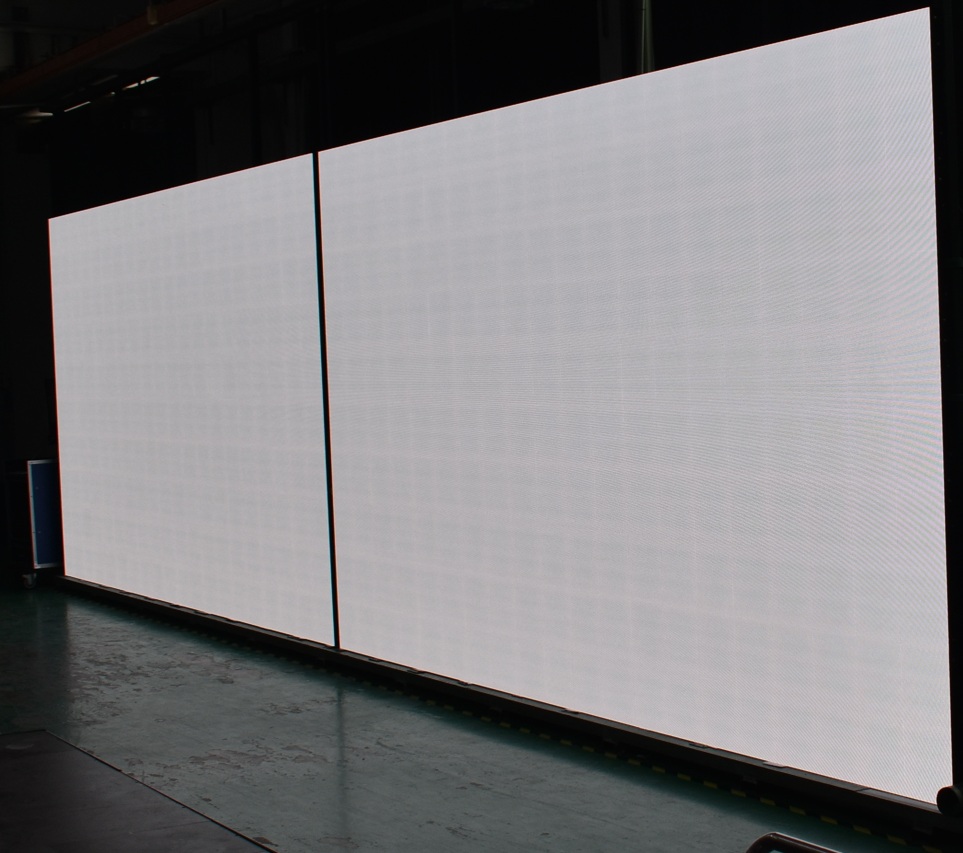
The Cause: How Heat Warps Your Colors
The root cause of these thermal patterns comes down to the fact that red LEDs are highly sensitive to temperature rises. As heat builds within a panel, the light output of the red LEDs degrades significantly faster than the blue and green components.
White uniformity requires a perfect, balanced blend of red, green, and blue. When localized overheating reduces the red output, it causes the white screen to shift color or dim in hot spots. This leaves behind unsightly thermal grids across your video wall.
When your manufacturer insists their standard is to measure 100% white brightness after only 5 minutes, you may find that this is an effort to avoid the appearance of the thermal pattern altogether. During our Factory Acceptance Tests (FATs), we check for thermal impact after 10 to 15 minutes of 100% white to see how the screen actually performs under real-world stress.
The Shortcut vs. The Structural Solution
To mask these thermal variations, many factories today rely on a temporary software shortcut—using pixel calibration or line correction software to digitally dim surrounding pixels to match the faded, overheated areas.
This shortcut fails to solve the root problem:
- It is only a temporary fix that does not correct the fault at all viewing angles.
- It may compromise uniformity when screen brightness (and therefore screen temperature) is lowered.
True reliability requires a better design fix centered on superior thermal management—such as high-conductivity PCB substrate engineering and enhanced heat dissipation—to ensure uniform heat distribution across the entire surface.
Why a Factory Acceptance Test (FAT) is Crucial
Once an LED screen is fully packed, paid for, and shipped across the ocean, fixing fundamental PCB design and heat dissipation flaws becomes a logistical nightmare.
An independent FAT before final payment allows you to run the display at full white and maximum brightness to catch these thermal shifts while the product is still on the factory floor. Our boots-on-the-ground team gives you the facts you need to resolve these and other issues with the manufacturer before shipment.
For inquiries about inspections or LED supply solutions, please reach out to me at the following link: https://www.linkedin.com/in/david-bateman-578b331a9/